Unequal pay. Domestic violence. Job discrimination. Unequal opportunity to education. Genital mutilation. These are just samples of the ongoing list of issues women have to face today.
I thought it would be appropriate to have my post for the month of March to be one dedicated to the Women’s Rights Movement, as it is Women's History Month. Even though I started this post from a negative angle, I must also shed light to recent achievements of women and the Women’s Movements. In the United States, Congress has achieved its largest number of women within the Senate. Women in Saudi Arabia were finally granted the right to drive. Women, all over the world, are becoming stronger, more prominent members of society. These achievements are not only a testament to the resilience of the Women’s Movement, but also reflect a shift towards a more equal future.
The Women’s Rights Movement is more relevant than ever. A plethora (and I mean a plethora) of sexual harassment cases have surfaced the media. The accused sexual violators range from prominent movie producers to Hollywood actors to former politicians to journalists. It is not ironic that the violators in the sexual abuse cases tend to be powerful individuals. Many of the victims of these cases may have felt like their accusation of the violators would simply be muted by a set of prominent lawyers. Considering the violators powerful roles, it has required every ounce of courage for the victims to speak up.
For example, over 150 women accused Larry Nassar, a former Michigan State University and USA Gymnastics doctor, of sexual harassment. He has since been sentenced to up to 175 years in prison. Like many Americans, I watched the testimonies of the victims with a heavy heart. Many of the girls admitted to a life of mental health complications due to Nasser's actions. Others mourned the loss of their childhood innocence. It was difficult to watch, but necessary to watch. The testimonies surfaced the emotional trauma caused by sexual abuse.
Again, courage was necessary for these women to testify before the man that violated them. This courage will hopefully empower victims, all over the world, to speak up when they encounter abuse. Let’s put an end to gender-based harassment, violence, and discrimination in order to promise a more equal future.
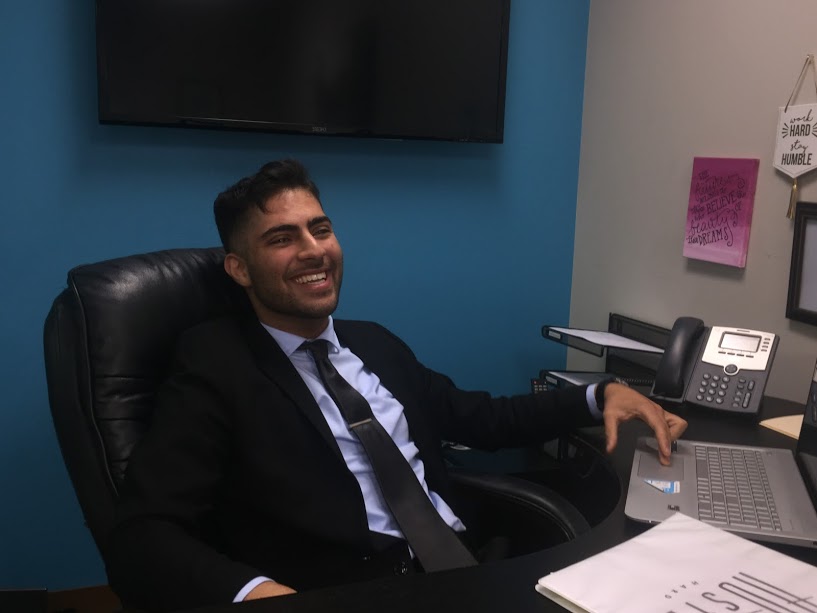
Mohamad Jaafar
CASL student majoring in Communication and Political Science
Thursday, March 22, 2018
Monday, June 13, 2016
UM-Dearborn and Beyond!
Freshman. Sophomore. Junior. Senior. Seems as though four years at UMD flew by just as fast as the amount of time it took for me to write those four words. At UMD, I majored in Political Science and International Studies with concentration in International Affairs and Spanish language. I was fortunate to have some incredible experiences because of UMD.
During my four years at UMD, I spent two semesters outside of Dearborn. During the Fall of 2014 I was a part of the UM Ann Arbor Michigan in Washington Program (MIW). Through this program, I was able to get a semester long internship in Washington, DC. I interned on the National Security and International Policy team at the Center for American Progress (CAP). During my time at CAP I did research assignments, wrote op-ed pieces with my supervisors and attended many events around Washington DC that related to my supervisors’ or my work and research. This was an immense learning experience.
As part of the MIW program I also had to do a research project of my choice. My project was about Ukraine as a buffer state in the middle of Europe. Furthermore, I had to attend a series of speaker events. I was fortunate enough to attend events with Undersecretary of State Catherine Novelli and former Governor of Louisiana Bobby Jindal. To make all of this better, most of the time free food is available at these events. While working at my internship and doing these extra tasks that were required from students by the program I grew professionally and learned how to network. DC provided me with lessons that one would never encounter in a classroom setting.
After my internship, my next adventure was in Mexico on a study abroad program. I participated in a Sol Education program in Oaxaca during the Winter 2016 semester. I took classes at a local university and lived with a host family. When I arrived in Mexico, I was pleasantly surprised at how much Spanish I understood after 3 years of Spanish classes at UMD. My university provided me with the skills I needed to be successful. I built on my Spanish language skills to the point where I could talk my way out of many situations while traveling throughout Mexico.
Mexico was a learning experience and again, I grew in ways that are not always possible in the classroom: how to build bridges with different people. Some people in Mexico, for instance, think that Soviet Union is still intact. As someone who is a news junkie, this was strange for me. However, I had to adapt and find common ground with people where it seemed as though common ground does not exist. Since I was living in a foreign country – I had no choice.
UMD has provided me with incredible opportunities and I am glad I took advantage. It is indeed true that some of the best classrooms do not have four walls and I encourage everyone to study abroad and intern at different organizations.
During my four years at UMD, I spent two semesters outside of Dearborn. During the Fall of 2014 I was a part of the UM Ann Arbor Michigan in Washington Program (MIW). Through this program, I was able to get a semester long internship in Washington, DC. I interned on the National Security and International Policy team at the Center for American Progress (CAP). During my time at CAP I did research assignments, wrote op-ed pieces with my supervisors and attended many events around Washington DC that related to my supervisors’ or my work and research. This was an immense learning experience.
As part of the MIW program I also had to do a research project of my choice. My project was about Ukraine as a buffer state in the middle of Europe. Furthermore, I had to attend a series of speaker events. I was fortunate enough to attend events with Undersecretary of State Catherine Novelli and former Governor of Louisiana Bobby Jindal. To make all of this better, most of the time free food is available at these events. While working at my internship and doing these extra tasks that were required from students by the program I grew professionally and learned how to network. DC provided me with lessons that one would never encounter in a classroom setting.
After my internship, my next adventure was in Mexico on a study abroad program. I participated in a Sol Education program in Oaxaca during the Winter 2016 semester. I took classes at a local university and lived with a host family. When I arrived in Mexico, I was pleasantly surprised at how much Spanish I understood after 3 years of Spanish classes at UMD. My university provided me with the skills I needed to be successful. I built on my Spanish language skills to the point where I could talk my way out of many situations while traveling throughout Mexico.
Mexico was a learning experience and again, I grew in ways that are not always possible in the classroom: how to build bridges with different people. Some people in Mexico, for instance, think that Soviet Union is still intact. As someone who is a news junkie, this was strange for me. However, I had to adapt and find common ground with people where it seemed as though common ground does not exist. Since I was living in a foreign country – I had no choice.
UMD has provided me with incredible opportunities and I am glad I took advantage. It is indeed true that some of the best classrooms do not have four walls and I encourage everyone to study abroad and intern at different organizations.
Taras Garapiak is a senior in CASL.
Tuesday, June 7, 2016
You know you are an English major when...
Although I am a CASL English concentrator who has analyzed thousands of words throughout these college years, my experience here has been about numbers. This will be comical to my friends and family because I have a hard time counting without using my fingers. I have been in college for five years, at UM-Dearborn for four years, changed my major three times, became a student at two UM-Dearborn colleges, and one goal: to graduate. These numbers surround my life; however, I have always immersed myself into words. My mother is an avid reader, and since I was young, I have mimicked many of her habits, including reading. I am sure this story is familiar to other English concentrators who were reading before they were talking. Since English concentrators love telling and reading stories, I have created a list of a story many of us can agree on: You know you are a CASL English concentrator when…
Microsoft Word is automatically set up to type in Times New Roman and 12 point font.
Your non-English concentrator friends ask you for help with their essays.
You can find a grammatical mistake in almost any scenario you are in. (Billboards on the
freeway, brochures in the doctor’s office, other professors’ syllabi)
Non-English concentrator friend complains, “I have a five page paper to write!”
English concentrator rolls eyes and says, “I have to read a novel I just opened today and write a
ten page paper about it. Want to trade?”
You skip class in order to write an essay for another class.
You have never admitted that you read Fifty Shades of Grey.
The Purdue Owl is the Bible.
Stranger: “What is your major?”
English student: “English.”
Stranger: “What are you going to do with that?”
Your professor asks the class, “Who liked the story?” Everyone raises their hands.
Your superpower is finding incorrect uses of their, there, and they’re.
You have had a least one family member tell you that you are not going to find a job after graduation.
You know every trick on Microsoft Word to make your essay the exact minimum length requirement.
You wish you could have partied with Scott and Zelda Fitzgerald.
You have the best imagination because through literature you have imagined hundreds of places.
Your other superpower is speed-reading an assigned text 30 minutes before class.
You bring your laptop to class and actually use it to take notes instead of Facebook.
You roll your eyes at people who say they don’t like Shakespeare because “they don’t understand it.”
You own one (or more) book cases and fill them completely.
You spend the whole year creating your “Summer Reading List.”
You roll your eyes at people who say, “I don’t like to read.” (Because none of us have to read anything on a daily basis.)
You realize books will always be better than their movies no matter which story it is.
You probably own one piece of clothing that references your favorite novel. (I have a Pride &
Prejudice scarf)
You are a writer in your spare time or dream of having time to write in your spare time.
You use correct grammar in your text messages and emails.
You have mastered the art of reading multiple pieces of literature at once.
You realize being an English major is the best major because you get to do your favorite hobbies
of reading and writing on a daily basis. (And you get graded on them!)
I know not every CASL English concentrator will agree with all of these items, but if someone can relate to at least one, then I will be happy. All CASL students have their own unique stories to tell and I am glad I was given the opportunity to tell mine. No matter what your CASL major is, go out into the world and make your story heard.
Samantha Belcher is a UM-Dearborn alumna, class of 2016.
Friday, March 11, 2016
My Time as a Social Justice Warrior
The social sciences at UM-Dearborn have honestly changed my outlook
on the world, the way I view my surroundings, and my entire plan for the
future. Since I was young, I’ve been really passionate about people and have
felt really strongly about the issues we have as a collective society. Going
into college and meeting other students who have this passion allowed us to
explore these things together and start to get involved in the world of
activism.
During my sophomore year, I heard about a new club starting
on campus called the Social Justice League. It was started by 3 women who were
majoring in Women and Gender Studies and I remember how incredibly informed and
passionate they were about issues that were going on at the time. From here, I
started getting more involved with professors on campus who were also working
toward social justice as well as groups in the Detroit area that were putting so
much work in to combat the many ways in which forces were working to oppress
and exploit people.
I ended up getting happily caught up in this web of networks
that brought me to so many incredible people, programs, classes, and projects
that sharpened my understanding of the world as well as created many more
questions. In essence, that has been my journey thus far: I’ve been able to be
inspired by so many incredibly passionate and powerful people and groups, and
as I learn from them, I realize how much left I have to learn.
This constant realization has led me to take advantage of
the many amazing opportunities we have on campus: academic service learning
courses, leadership programs, impactful centers, transformative departments,
energetic professors, engaging research, and a wealth of chances to be engaged
in the community around us. From all of these things, I’ve learned about how
the world around us was built and how it primarily serves specific identities. I’ve
learned about what the news won’t show us, what textbooks don’t teach us, what
people refuse to acknowledge, and how all of this is creating patterns in our
world.
Majoring in Urban and Regional Studies has exposed me to
some of the most motivated professors and honest courses. In all of my years of
education, I’ve never been exposed to so much truth. I’m so blessed to be
surrounded by people who have a stake in this movement to fix all that we have
broken in our past. I have also been blessed to cross paths with so many people
who are majoring in Women and Gender Studies, Sociology, International Studies,
and all sorts of other incredible things. It is even greater to know that there
is a deep understanding that our position at a university is strategic and a
privilege that we need to use to rid our world of systems that do nothing to
alleviate the many issues we have impressed upon people.
The social sciences here have absolutely provided me with so
much in such a short amount of time. Above all, they taught me the importance
of learning by experience: It is not nearly enough to read a textbook. There
are so many things going on in the world and to assume that reading will allow
us to understand it all is dangerous. While it may be impossible for a person
to truly understand every issue that is going on in the world, I understand
that the education I am receiving is a tool that can and should be used. It is
something I can offer to community groups and projects in an effort to build
solidarity and collective consciousness among those who have not been exposed
to these things. Without these resources at school, I would probably not be
doing any of these things, and I can’t imagine how dangerous that would be.
Teia McGahey is third year student at the University of Michigan- Dearborn majoring in Urban and Regional Studies. She is a member of a number of student organizations including the Social Justice League, Circle K International, Food Recovery Network, She's The First, and Student Government. She is also a part of a statewide coalition of students, the Michigan Student Power Network, that work to fight oppressive structures that further oppress marginalized groups.
Friday, February 19, 2016
Confessions of a "Professional Student"
I'm Allison. And after over 5 years of indecision, you can call me a "professional student."
You'd think that by now I'd have it all figured out. You'd think that after 5 years ofcramming developing efficient study plans, reading almost every academic article in existence, and writing essays until my knuckles went numb, I could have come to even the most basic conclusion of what I want to do after I graduate. But the more work I do, the more I discover that my "life plan" is far from complete. The question of, "What are you doing after graduation, Allison?" plagues virtually every family function and causes me to want to rip my hair out strand-by-strand. What AM I doing after graduation?
College is the stepping stone into the rest of your life, and if you don’t have it figured out by graduation, all the signs point to a lifetime of mundane tasks and insufficient self worth. Spatulas and greasy hamburgers haunt my dreams.
And this is something that we’ve been inadvertently told our entire lives. Virtually every adult from the age of four onwards has asked me, “What do you want to be when you grow up, Allison?” At four, my answer would have been, “a Ballerina!” But at the age of eight, I stormed out of my dance class, defeated upon discovering I have two left feet.
At the age of twelve, I would have told you that I was going to be a singer; that was until I found out that I would be rejected from the lead part in Oklahoma! for being too “pitchy.” At the age of 15, I was going to be a psychologist, but that was mostly because I was ready to figure out my own inevitable teenage angst. At the age of 17, I was going to be a radio broadcaster, and half-way through my first year of college at 18, I no longer had an answer.
This turned into a joke for awhile. “What are you majoring in, Allison?” resulted in a light-hearted response of, “it’s a surprise.” I spent the next couple of years of college in this similar sort of "let's-fly-by-the-seat-of-our-pants" mentality, but by 21, these responses were no longer funny.
Enter panic mode.
Here I am: 21 years old. In my third year of college. And am still grappling with that age-old question of "what do I want to be when I grow up?" And just as I was four, and eight, and twelve, and fifteen... I hadn't the faintest idea.
So I began a process of trial and error. I tried out a couple classes and student organizations until I found something that did more than just vaguely interest me. I wanted to find something that I was so passionate about that I couldn't sit still while talking about it. And then I found Blueprints.
Blueprints is a metro-scholars program offered on campus that allows students to develop leadership skills. And it did this. But it also gave me the opportunity to hone in on the issues I cared about, the leadership I was hoping to take on, and the skills that I possessed and wished to make better, all while forcing me to believe that the goal after college was not to just "find a job" but to make myself into a leader; someone that could make a real change and difference.
And this program forced me to do a little bit of reading. I read about issues of social injustice. I read about power dynamics. I read about inequality. And poverty. And opportunity. I became aware of the state of the society we lived in; and I felt it. I couldn't sit still.
I declared my major and minor shortly thereafter: Communications with a minor in Women and Gender Studies. And with this declaration I found myself growing more and more confident in my decision. My classes, while providing me with the most useful information related to my future endeavors, also provided me with the ability to come to information, events, and places with a critical eye. My professors have taught me to question everything, and to never stop asking questions. They have taught me that my will to learn shouldn't stop once I've turned over my tassel.
I still don't know where I'm going. The question has changed from, "What are you going to be when you grow up" to "What are you going to do post-graduation." I still can't answer these questions specifically. But I'm a bit calmer now. I thankfully have a pocket full of perspectives and skills that I am so lucky to have received. And while I don't know what lies ahead in the next year, I now know which road to take. And frankly, that's all I need to know. That's what makes this whole thing exciting.
Allison Wilke is a CASL Senior majoring in Communications and minoring in Women and Gender Studies. She is an Avid cat lover, human rights activist, and writer. You can check out some of her other random musings at adailyepiphany.wordpress.com
You'd think that by now I'd have it all figured out. You'd think that after 5 years of
College is the stepping stone into the rest of your life, and if you don’t have it figured out by graduation, all the signs point to a lifetime of mundane tasks and insufficient self worth. Spatulas and greasy hamburgers haunt my dreams.
And this is something that we’ve been inadvertently told our entire lives. Virtually every adult from the age of four onwards has asked me, “What do you want to be when you grow up, Allison?” At four, my answer would have been, “a Ballerina!” But at the age of eight, I stormed out of my dance class, defeated upon discovering I have two left feet.
At the age of twelve, I would have told you that I was going to be a singer; that was until I found out that I would be rejected from the lead part in Oklahoma! for being too “pitchy.” At the age of 15, I was going to be a psychologist, but that was mostly because I was ready to figure out my own inevitable teenage angst. At the age of 17, I was going to be a radio broadcaster, and half-way through my first year of college at 18, I no longer had an answer.
This turned into a joke for awhile. “What are you majoring in, Allison?” resulted in a light-hearted response of, “it’s a surprise.” I spent the next couple of years of college in this similar sort of "let's-fly-by-the-seat-of-our-pants" mentality, but by 21, these responses were no longer funny.
Enter panic mode.
Here I am: 21 years old. In my third year of college. And am still grappling with that age-old question of "what do I want to be when I grow up?" And just as I was four, and eight, and twelve, and fifteen... I hadn't the faintest idea.
So I began a process of trial and error. I tried out a couple classes and student organizations until I found something that did more than just vaguely interest me. I wanted to find something that I was so passionate about that I couldn't sit still while talking about it. And then I found Blueprints.
Blueprints is a metro-scholars program offered on campus that allows students to develop leadership skills. And it did this. But it also gave me the opportunity to hone in on the issues I cared about, the leadership I was hoping to take on, and the skills that I possessed and wished to make better, all while forcing me to believe that the goal after college was not to just "find a job" but to make myself into a leader; someone that could make a real change and difference.
And this program forced me to do a little bit of reading. I read about issues of social injustice. I read about power dynamics. I read about inequality. And poverty. And opportunity. I became aware of the state of the society we lived in; and I felt it. I couldn't sit still.
I declared my major and minor shortly thereafter: Communications with a minor in Women and Gender Studies. And with this declaration I found myself growing more and more confident in my decision. My classes, while providing me with the most useful information related to my future endeavors, also provided me with the ability to come to information, events, and places with a critical eye. My professors have taught me to question everything, and to never stop asking questions. They have taught me that my will to learn shouldn't stop once I've turned over my tassel.
I still don't know where I'm going. The question has changed from, "What are you going to be when you grow up" to "What are you going to do post-graduation." I still can't answer these questions specifically. But I'm a bit calmer now. I thankfully have a pocket full of perspectives and skills that I am so lucky to have received. And while I don't know what lies ahead in the next year, I now know which road to take. And frankly, that's all I need to know. That's what makes this whole thing exciting.
Allison Wilke is a CASL Senior majoring in Communications and minoring in Women and Gender Studies. She is an Avid cat lover, human rights activist, and writer. You can check out some of her other random musings at adailyepiphany.wordpress.com
Friday, December 11, 2015
A View from the CASL: Psychology Reflection
I’m Najat Nahshal, and I am honored to be voted by UM-D faculty as one of the top 10 psychology students of 2014-2015. I just want to say that throughout my undergraduate career at UM-D, the CASL building really was my second home. I basically lived there on a daily basis. From the hangouts with friends in the CASL atrium between classes, to running participants in psych labs on the fourth floor, to the last minute study session in the Language lab before exams, CASL really was my favorite building on campus.
I was a psychology major, with a minor in Arabic studies, and I have to say that I had the best professors in the whole wide world. I was (and still am) a research assistant for Dr. Clark-Foos for over a year now. I must say that Dr. Arlo pushed me, and the rest of the lab, outside our comfort zone because he really believed in our potential. I will never forget my oral presentation at the CASL undergraduate research showcase. I would have never imagined having the guts to speak in front of an audience about my findings, if it wasn’t for Dr. Clark-Foos’ belief in me as a researcher to do both an oral presentation for one project, and a poster presentation for the other. Dr. Clark-Foos continued his mentoring as I went on to present at the MPA conference in Chicago, as well as the Meeting of Minds conference.
Additionally, I was a research assistant for Dr. Siefert, who also believed in me so much that he allowed me to present my research at both the CASL showcase and the Meeting of Minds conference, even though I had just started working in his lab a few short months ago. Dr. Siefert was also my advisor for psych club, and as President of Psych club, I collaborated with Dr. Siefert and with hard work and dedication from him and the rest of the psych club members, we were able to put together a memorable Mental Health Week: Suicide Awareness campaign on campus this year!
I also want to shout out my Arabic Studies Professor, Dr. Dika, who believed in me a great deal throughout my Arabic courses, and made me feel accomplished even when I was struggling to understand the foreign material. His constructive criticism and feedback made me push myself to study that much harder and prove to him that I was taking his advice and doing everything I can to improve!
Also, the feedback I received from my other Professors, such as Dr. Sethuraman, who taught me Psychology of the life-span course, and Dr. McAuslan who taught me Social Psychology, really helped me reach my maximum potential as a student. I remember randomly stopping by Dr. Sethuraman’s office and just talking to her about my grad school goals and dreams. Her advice to me was to never throw out my psychology textbooks, but instead, save them and use them as a personal library that I could reference throughout my career. I also remember Dr. McAuslan stopping me after the final exam in her course, and telling me that she recommended me to become an SI Leader, not knowing that I had been an SI leader for about a year (Professor Roundtree, I hope I made you proud!!)
Lastly, shout out to Dr. Swift, who taught me Experimental Psychology. That was by far the hardest course of my undergraduate career. At times, I felt like Dr. Swift had mistaken us for upper-level graduate students because of the complexity of the material he was teaching (sorry to put you on blast Dr. Swift). However, I used this adversity as motivation to study even harder for his course. Going into his class, I had a perfect psychology GPA of a 4.0 (and a cumulative GPA of a 3.9), and I wanted to do everything I could to maintain my straight A’s. I remember being so nervous about my grade towards the end of the semester, that I asked him “Dr. Swift, do you EVEN give out A’s? Or is there no such thing?” and I remember him laughing at me and assuring me that he does in fact give out A’s to those who earn them. Thankfully with (extremely) hard work and dedication, I survived his class with an A, and my perfect psychology GPA survived as well.
I honestly cannot express in words how my undergraduate career as a CASL student shaped the person I am today. I only shared a fraction of my experience at CASL, but let it be known that there were so many more memorable moments that I will never forget. Although the bulk of my piece focused on my relationship with the best faculty in the world, I just want to shout out all of the students, my classmates, my friends, who made my undergraduate career worthwhile. I met students from different countries, cultures, and backgrounds; I heard their stories, and although on the surface we seemed so different, in reality we were so much alike. I met some of my best friends in CASL, and I know that our friendship will remain even after we part ways and continue on in our respective career paths.
Additionally, I was a research assistant for Dr. Siefert, who also believed in me so much that he allowed me to present my research at both the CASL showcase and the Meeting of Minds conference, even though I had just started working in his lab a few short months ago. Dr. Siefert was also my advisor for psych club, and as President of Psych club, I collaborated with Dr. Siefert and with hard work and dedication from him and the rest of the psych club members, we were able to put together a memorable Mental Health Week: Suicide Awareness campaign on campus this year!
I also want to shout out my Arabic Studies Professor, Dr. Dika, who believed in me a great deal throughout my Arabic courses, and made me feel accomplished even when I was struggling to understand the foreign material. His constructive criticism and feedback made me push myself to study that much harder and prove to him that I was taking his advice and doing everything I can to improve!
Also, the feedback I received from my other Professors, such as Dr. Sethuraman, who taught me Psychology of the life-span course, and Dr. McAuslan who taught me Social Psychology, really helped me reach my maximum potential as a student. I remember randomly stopping by Dr. Sethuraman’s office and just talking to her about my grad school goals and dreams. Her advice to me was to never throw out my psychology textbooks, but instead, save them and use them as a personal library that I could reference throughout my career. I also remember Dr. McAuslan stopping me after the final exam in her course, and telling me that she recommended me to become an SI Leader, not knowing that I had been an SI leader for about a year (Professor Roundtree, I hope I made you proud!!)
Lastly, shout out to Dr. Swift, who taught me Experimental Psychology. That was by far the hardest course of my undergraduate career. At times, I felt like Dr. Swift had mistaken us for upper-level graduate students because of the complexity of the material he was teaching (sorry to put you on blast Dr. Swift). However, I used this adversity as motivation to study even harder for his course. Going into his class, I had a perfect psychology GPA of a 4.0 (and a cumulative GPA of a 3.9), and I wanted to do everything I could to maintain my straight A’s. I remember being so nervous about my grade towards the end of the semester, that I asked him “Dr. Swift, do you EVEN give out A’s? Or is there no such thing?” and I remember him laughing at me and assuring me that he does in fact give out A’s to those who earn them. Thankfully with (extremely) hard work and dedication, I survived his class with an A, and my perfect psychology GPA survived as well.
I honestly cannot express in words how my undergraduate career as a CASL student shaped the person I am today. I only shared a fraction of my experience at CASL, but let it be known that there were so many more memorable moments that I will never forget. Although the bulk of my piece focused on my relationship with the best faculty in the world, I just want to shout out all of the students, my classmates, my friends, who made my undergraduate career worthwhile. I met students from different countries, cultures, and backgrounds; I heard their stories, and although on the surface we seemed so different, in reality we were so much alike. I met some of my best friends in CASL, and I know that our friendship will remain even after we part ways and continue on in our respective career paths.
Friday, December 4, 2015
Going back in Time at le Château de Versailles
It was not too long ago when I was able to see the fireworks exploding. Fireworks have always had their own beauty with a vast range of colors from red, blue, green, purple, and orange. On top of the fireworks, there was a fire show happening at the same time as the fireworks with French music playing in the background to match the mood. Being here, you felt warm and there was a sense of you going back in time around the early 1700’s. I was able to see the fountains running at night, which were also illuminated with deep violets, red, and a dull orange color.
I saw a statue surrounded by smoke and lasers. They had smoke covering the ground making it more magical. It was stunning to see not only le château de Versailles lit up at night but also to see the fountains and fireworks. This is something you do not get to see everyday, even in France. I made a French friend who used to be a tour guide at le château de Versailles. He explained, to our small group, the story behind all of the fountains and the process of building le château de Versailles. After that night, I never understood why we do not appreciate history as much as the French do. Historically, everything that we are and everything that we have is because of our history. It is a shame that we do not value those who take the time out to learn about the history of not only our country but the history of others. History seems to be ingrained in every class that I have at the University. Although I may be learning about French literature in the 20th century, grammar, and speech there is always a history lesson for the way things used to be and how the are today. In my opinion, I feel like this has helped me remember all of the information better because it is like a small glimpse back in time.
Friday, October 30, 2015
Right Choice? Right Choice. Right Choice!
My major is in Behavioral Sciences and my minor is in African and African American Studies. Declaring both of these areas came with many questions from people. When I declared my major in Behavioral Sciences, I was an incoming freshman who had to make a decision. I had heard that it was best to go into college with a major even if you had to change it later. So I sat in my mom’s office at work going over the packet of information we had gotten at the freshman orientation. I had the University of Michigan Dearborn class catalog in one hand and major description packets in the other. I was trying to see what “fit” me.
After talking with my mom, she helped me realize that I loved helping people. My name means “helper and defender of mankind”, and that is exactly what I have always done and love to do. I immediately looked at the social sciences and after reading the descriptions, saw that Behavioral Sciences was for me! People asked what I was going to do with the degree and if I thought I would make any real money. I cannot say that over the past 4 years I have not asked myself those same questions. BUT, every single time I find that I am content in knowing that this is what God has called me to do and this is the field that He has placed me in, and….I LOVE IT!!
The College of Arts, Sciences, and Letters is amazing. No matter what your discipline, you can feel the care, concern, love, and empathy of the staff within this college! Whether I was in a class for my major/ minor such as Marriage and Family problems or Black Family in Contemporary America or I was in an elective class such as Spanish I or Women’s Film Studies, I could feel that the professors cared for me and truly wanted to see me succeed in whatever area I was going into.
Declaring my minor in African and African American studies came with a few questions as well. As I always tell people, choosing this minor had nothing to do with me being African American. But it was chosen because I want to help people. People of all colors and creeds. People who need advocates or just someone who they know cares for them. I found it amazing to be able to study a people who have been through so many greatly documented struggles, triumphs, and ongoing battles. Being able to study the poems, novellas, essays, legal documents, and other historical artifacts of great African American citizens (even before they were recognized as such) has allowed me to not only look at African Americans in a new light, but all people in a new light.
No matter the differences, we are all human. Being able to study the struggles, victories, and perseverance of this group will allow me to connect and have greater empathy for any group of people I come into contact with throughout my counseling and therapy career. This is why I studied African and African American studies as well as Behavioral Sciences. I will continue to help people.
The staff, students and faculty at UM Dearborn CASL are the ABSOLUTE best!! The atmosphere is exciting and inviting. Everyone encourages you to do your best and push yourself. Take risks to talk to professors and ask questions-go above and beyond! Professors are understanding of our busy, busy lives, yet also don’t let us use our busyness as excuses, but they work with us to push ourselves to greater heights.
I am extremely grateful to be graduating from CASL within U of M-Dearborn. I am completely grateful and give all credit to God almighty for real. It is only with him that I have been able to do this and continue to grow and mature even more. This is such a complete honor. I always aim to work hard and give God my absolute best in any and everything I am involved in. I try to help and contribute to anyone that I can and gain wisdom from every faculty person that is willing to give it.
I am so happy to be at the University of Michigan-Dearborn and in the Behavioral Sciences Department. I am so completely honored by the Behavioral Science Honor Scholar award. I know that so many of my classmates are phenomenal.
I thank all of the Behavioral Sciences faculty that have poured into me and my education and continue to support me; faculty I have met and ones I have not yet met. This is a GREAT School!
After talking with my mom, she helped me realize that I loved helping people. My name means “helper and defender of mankind”, and that is exactly what I have always done and love to do. I immediately looked at the social sciences and after reading the descriptions, saw that Behavioral Sciences was for me! People asked what I was going to do with the degree and if I thought I would make any real money. I cannot say that over the past 4 years I have not asked myself those same questions. BUT, every single time I find that I am content in knowing that this is what God has called me to do and this is the field that He has placed me in, and….I LOVE IT!!
The College of Arts, Sciences, and Letters is amazing. No matter what your discipline, you can feel the care, concern, love, and empathy of the staff within this college! Whether I was in a class for my major/ minor such as Marriage and Family problems or Black Family in Contemporary America or I was in an elective class such as Spanish I or Women’s Film Studies, I could feel that the professors cared for me and truly wanted to see me succeed in whatever area I was going into.
Declaring my minor in African and African American studies came with a few questions as well. As I always tell people, choosing this minor had nothing to do with me being African American. But it was chosen because I want to help people. People of all colors and creeds. People who need advocates or just someone who they know cares for them. I found it amazing to be able to study a people who have been through so many greatly documented struggles, triumphs, and ongoing battles. Being able to study the poems, novellas, essays, legal documents, and other historical artifacts of great African American citizens (even before they were recognized as such) has allowed me to not only look at African Americans in a new light, but all people in a new light.
No matter the differences, we are all human. Being able to study the struggles, victories, and perseverance of this group will allow me to connect and have greater empathy for any group of people I come into contact with throughout my counseling and therapy career. This is why I studied African and African American studies as well as Behavioral Sciences. I will continue to help people.
The staff, students and faculty at UM Dearborn CASL are the ABSOLUTE best!! The atmosphere is exciting and inviting. Everyone encourages you to do your best and push yourself. Take risks to talk to professors and ask questions-go above and beyond! Professors are understanding of our busy, busy lives, yet also don’t let us use our busyness as excuses, but they work with us to push ourselves to greater heights.
I am extremely grateful to be graduating from CASL within U of M-Dearborn. I am completely grateful and give all credit to God almighty for real. It is only with him that I have been able to do this and continue to grow and mature even more. This is such a complete honor. I always aim to work hard and give God my absolute best in any and everything I am involved in. I try to help and contribute to anyone that I can and gain wisdom from every faculty person that is willing to give it.
I am so happy to be at the University of Michigan-Dearborn and in the Behavioral Sciences Department. I am so completely honored by the Behavioral Science Honor Scholar award. I know that so many of my classmates are phenomenal.
I thank all of the Behavioral Sciences faculty that have poured into me and my education and continue to support me; faculty I have met and ones I have not yet met. This is a GREAT School!
Friday, October 16, 2015
I once lived in a Castle but now I am climbing up the Eiffel Tower
Once Upon A Time, there was a young man who lived in a castle and studied French and Linguistics. His passion for French and Linguistics took him across the world to climb up the Eiffel Tower but who knew it would happen so soon? After having lived in France for more than a month, as not only as an exchange student but also as a French major with a minor in Linguistics, I cannot express how it feels to get to the top of the Eiffel Tower. It was not too long ago that I was staring upwards as the Eiffel Tower lit up the surrounding area.
However, before this all happened it was definitely a struggled but I owe it all to my professors: Gabriella Eschrich, Lindsay Colby, Stéphan Spoiden, Jamie Lee, and Daniel Davis. All of these amazing professors have showed me in various ways what it means and what it takes to think outside the box. I was challenged academically but they all saw more potential in me and encouraged me to take this journey abroad.
I must admit being a French major in CASL is somewhat rare and that is a good thing. It definitely takes a special person to continue with a foreign language because ultimately it is another way of thinking about the world and perceiving the world. I guess those who study foreign languages have something in common with all the soldiers who fought throughout the night so we could be here today. We are dedicated, open minded, able to adapt to various environments and can find a way to survive.
After studying French for 4 years, I thought I would have all the tools needed but I was wrong. Learning a foreign language is a lifetime task. For example, My first week in France I had to open up a bank account and do various other normal things such as: getting health insurance, getting directions to the bus or train station, ordering food, buying supplies such as a fitted bed sheet, Band-Aids etc. I did not have the knowledge of how to express those things. Immediately I wanted to turn around and go back home because I was outside my comfort zone.
The days dreadfully went by going into my second week. I went to the welcome week events where I met more ERAMUS students from all over Europe, South Korea, Africa, South America, Greenland, and the UK. Linguistically and Culturally, I was enchanted and consumed by how different we all were but we had one goal in mind that lead us here. Yet, I felt disgusted. I was disgusted by everything and how I missed some of the most annoying things in America. I missed the annoying sound of the microwave going off, driving in traffic, all of the detours because of construction on the roads in Michigan, my friends, and my family. I missed it all. Most importantly, I felt challenged and alone.
However, I soon realized that I was changing the entire time by being here. I had to accept the fact that everybody does not get this opportunity. Yes… it sucked at times dealing with a new culture and depending on the train or bus. One night though it was raining and some of the ERAMUS students and I went to see la basilique du sacré-cœur and there was a warm wave of content that engulfed me. My perspective on France changed slowly just as you awaken from a long dream. Looking back, I was able to see Monuments that people dream of seeing their entire life and that is a privilege. I want to thank Maureen Linker who taught me that we often fail to see when we are privileged but can see when we are oppressed. After noticing that I felt like it was my duty to take this experience and show it to those who may not get this chance. I wanted to use my privilege by being here and share it with others. I have been recording all of my adventures traveling around Paris for the past month. Through the dimly lit alleys on those rainy nights to walking past the Eiffel tower on the sunny days. My friends and family have seen all that I can see. I owe them that much. Indeed, my intention is not to brag about how I am here but to inform the readers that if your dreams do not scare you then they are not big enough and you never know where your dreams will take you and who you can meet. I have not grown in ways that I hoped I would by coming here, maybe I just have not noticed yet, but I have grown in many other ways.
The days dreadfully went by going into my second week. I went to the welcome week events where I met more ERAMUS students from all over Europe, South Korea, Africa, South America, Greenland, and the UK. Linguistically and Culturally, I was enchanted and consumed by how different we all were but we had one goal in mind that lead us here. Yet, I felt disgusted. I was disgusted by everything and how I missed some of the most annoying things in America. I missed the annoying sound of the microwave going off, driving in traffic, all of the detours because of construction on the roads in Michigan, my friends, and my family. I missed it all. Most importantly, I felt challenged and alone.
However, I soon realized that I was changing the entire time by being here. I had to accept the fact that everybody does not get this opportunity. Yes… it sucked at times dealing with a new culture and depending on the train or bus. One night though it was raining and some of the ERAMUS students and I went to see la basilique du sacré-cœur and there was a warm wave of content that engulfed me. My perspective on France changed slowly just as you awaken from a long dream. Looking back, I was able to see Monuments that people dream of seeing their entire life and that is a privilege. I want to thank Maureen Linker who taught me that we often fail to see when we are privileged but can see when we are oppressed. After noticing that I felt like it was my duty to take this experience and show it to those who may not get this chance. I wanted to use my privilege by being here and share it with others. I have been recording all of my adventures traveling around Paris for the past month. Through the dimly lit alleys on those rainy nights to walking past the Eiffel tower on the sunny days. My friends and family have seen all that I can see. I owe them that much. Indeed, my intention is not to brag about how I am here but to inform the readers that if your dreams do not scare you then they are not big enough and you never know where your dreams will take you and who you can meet. I have not grown in ways that I hoped I would by coming here, maybe I just have not noticed yet, but I have grown in many other ways.
Tyree Martin is a French major with a Linguistics minor studying abroad at the University of Versailles. He'll be posting regularly about his semester in Europe.
Friday, October 2, 2015
"Uncomfortable is Good"
Strange is the world (according to Czesław Niemen), and stranger
than all is Poland. It’s a phoenix country led by a phoenix capital, rebuilt by
the mythic Robinsons on ashes and ruins. A land of magic, where fire-breathing
dragons still guard castles as in Krakow. A country marked by layers of sadness
and horror of wars and occupation and partition, yet experiencing
breathtakingly rapid change and growth. A place now experiencing brain-drain
and exodus of the younger generation but also home to the optimistic hipsters
and do-it-yourself, build-it-yourself, make-it-yourself go-getters bringing
fresh life to urban decay. It’s a place you can’t just read about and you can’t
visit without being changed.
Stepping out of the Krakow airport with my motley group of
acquaintance-students, riding a terrifyingly fast taxi through a strange city
in East-Central Europe, I seriously doubted why I decided to come half way
across the world to a country I knew virtually nothing about. Over the next
four weeks, we wandered through tons of museums, read through a stack of
journal articles, met with researchers, went on guided tours, and learned about
the past century of Polish history.
“Uncomfortable is good,” Professor Anna Muller said
repeatedly. “That’s when you learn. That’s where you can be creative.” These
words were often a source of encouragement for me because living normal life
without speaking Polish was often tricky and sometimes awkward and a little
scary. There was one evening when I was feeling proud of myself successfully
ordering something vegetarian at a milk bar with the help of a nice lady behind
me... and my food ended up being a sugar covered rice, jelly and sour milk
concoction of stomachache doom. But there was also this fantastically pink soup
(Chlodnik) we called Pepto-Bismol soup and the wonderful invention of fresh strawberry
pierogi.
There were also [lots of] moments when I never wanted to come
home and I would get lost in blissful thought, scheming ways to stay in Poland or
at least move there after I finished my degree. (I’m still dreaming one day of
spending a year or two in Lublin learning Polish.)
There can’t be anything to beat sipping coffee in the Zielony
Balonik while reading about the historical cabaret and then wandering the rooms
to see the actual cartons made by and portraying the people discussed in our
text. Unless, of course, it would be random evening coffee with polish artists
who encouraged my artwork and whose exhibits I could often see in museums the
next day. Or unless it would be wandering through the eerily empty Gdansk
shipyard where Solidarność was born after meeting with Lech Wałęsa and hearing
his thoughts on the young people’s role in modern solidarity. Or finding the graffiti
that bored Polish nobles carved into the walls of the Holy Trinity Chapel in
the Lublin castle in the 1600s. (We were almost the only ones there in the
history-laden chapel, once a prison and now stripped of any religious vestiges
except the chipping frescos.) ...Ok, so I guess there were a lot of
“unbeatable” moments.
Poland also has—without question—the coolest museums I’ve
ever experienced. Be it the Krakow city museum catacombing under the market
square to show the city’s foundations, to the artifact-filled Solidarność
museum, situated in the historic shipyard, to the uncertainly undulating spaces
of Polin, to the chaotic, terrifying sensory explosion of the Uprising Museum
in Warsaw, to the yet unbuilt WW2 museum in Gdansk whose artifact catalogue we
were beyond lucky to be allowed to explore... there is nothing to compare to
these museums.
Oh, and did I mention that Poland is just plain beautiful?
Because it is. Castles, Tatras,
Krakow, the Baltic, Warsaw... there is so much to see and be
in awe at.
Sure, I could have read about Polish history at home, could have watched the Katyń movie on my own, could have researched the holocaust at a local museum. But meeting with the people still pursuing justice for holocaust victims at the Institute for National Remembrance, hearing Bór-Komorowski’s son tell stories of his father in the room in the Jagiellonian University where the professors were assembled before being taken by the Nazis, even just drinking polish beer with Polish university students from Gdynia—these real experiences are where the deeper learning took place that could never have been reached simply through the comfort of my laptop at home. Sure, at times it was uncomfortable or strange—travel always is—but Poland is an awesome place and I hope one day I’ll be able to return.
-Taylorann Lenze
The University of
Michigan-Dearborn’s “Memory and Oblivion: Polish and Polish-Jewish history in
the Polish Modern Landscape,” led by faculty members Dr. Anna Muller and Dr.
Jamie Wraight, was a 4-week history study abroad through Krakow, Zakopane,
Lublin, Lodz, Warsaw, and Gdansk.
Tuesday, July 7, 2015
Dziękuję, Polska!
“Thank you, Poland!” for everything you taught me, and I daresay all of my classmates. We spent 28 days within some of your cities: Kraków, Zakopane, Lublin, Łódź, Warsaw, and Gdańsk. Each of those cities had something new to teach us about history and culture. Everyday we saw something different, painting a picture in my mind of a country whose complex story still begs to be told to anyone who will take the time to truly listen.
I was fortunate enough to have already taken classes with both professors who led our trip, Anna Muller and Jamie Wraight. Professor Muller is a native of Gdańsk; her love of Poland and desire to show us everything it had to offer was evident. Dr. Wraight is a Holocaust historian whose work in the Voice/Vision Archive at UM-Dearborn enhanced the information he was able to tell us while touring concentration camps on the trip. Both of these professors brought something different to the table for all of us to learn from, and it offered an opportunity for students who had different interests to chase them and look to the professor who might offer them the best insight into the topic they wished to pursue for the trip.
Having just finished a semester studying the Holocaust with Dr. Wraight, my focus on the trip was initially just that, with emphasis on the design of the concentration camps which was what my research paper for his class was on. I immediately discovered, though, that there was a much larger story to be told in these places. Much of our trip was focused on the Jewish-Polish history and relationship, something that continues to change even today. We toured many of the Jewish ghettos: Porgorze near Kraków and those in Lublin, Łódź, and Warsaw. In these places, it is evident that the people who eventually had their lives taken in the concentration camps or extermination camps had stories.
As our guide at the Bełżec extermination camp told us, “Although we do not know the names of the people who came here, we have to remember they were people. For so many, this is where their story ended; but we cannot forget they had a story before the war.” I’m obviously paraphrasing. I tried to write down what she said in a note on my phone but I’m not nearly fast enough. What she meant was clear, though; and it was echoed by our guide in Łódź when we visited the cemetery that was within the ghetto there at the time of the war. She said, “There are 150,000 graves here. That means there were 150,000 people. That means there are 150,000 stories.” Over 43,000 of those stories ended in the ghetto – but they still have something to say. In the Jewish cemeteries we visited, trees and grass have begun to overrun the graves and shape a new landscape. To me, this was almost a sign of life in places that people had been forgotten or abandoned. Groups spend time cleaning these graves throughout the year. Our guide in Łódź said that when she and her friends clean a grave and finally see a name, they talk about who this person may have been; what their story might have told. In Lublin, we went to an archive where the workers are trying to piece together a history of the city by documenting who lived in each of the buildings. Their task seems almost impossible because for some places, they do not know the full names or where the people went. If only the walls could speak, I suppose. The walls of the houses and of the ghettos, the trees in the streets and the trees around the camps we visited – all six of them – are the silent witnesses of the history we learned.
Again, if only they could speak.
That’s not to say our entire trip was rooted in the losses from the Second World War because they are seemingly impossible to ignore. It’s easy to forget that a country whose landscape was completely decimated by total war had a story beforehand. The streets are rebuilt, although changed to be more modern. In Warsaw, communist buildings dominate many areas – and you can imagine the jokes we made about our hotel which was in one of these buildings. It is also easy to look primarily at a Jewish history so easily intertwined in the story of the Polish people. Because what is Poland and who is Polish? A country whose history is so complex from its infancy can struggle with that question – and so can the people who study it. When we were in Zakopane, a small city which I equated to Poland’s own Gatlinburg, we talked about how such a place can become the focus of study for what is “Polish.” It’s a place left untouched by war and partitions. It was able to grow with its own culture. It is “Polish.” But so are many other things.
Some of us had the opportunity to meet Lech Wałęsa, who was the leader of the Solidarność movement that began in the shipyards of Gdańsk in 1980 (which to some – and certainly to him – is the real spark of the down fall of communism in Europe) and the first post-communist president of Poland. Although his political beliefs have not always remained popular, he said many things that I believe ring true for all of us. He told our group and a group of German students that his generation fought communism so we would not have to, so we could have more opportunities than their generation could ever dream of. It is now our job to use those opportunities to change the world. He said that he was able to be successful with Solidarność because he believed in it with his whole heart; and if there is something we are so passionate about, we should do everything within our power to achieve it. I wanted to ask him if he ever imagined the impact Solidarność would have on the world. It was lost in translation and I think became more of a question if he ever imagined the impact he would have. He spoke about the movement like a chain. Some links can carry more weight than others; but you have to be careful not to give one link too much or it will break and run away; every link is needed for the movement to be successful. He just happened to be the first link. The most valuable thing he said, I think, was that when we try to make these changes to our world, we have to listen to everyone around us. The opinions of everyone need to be heard before it can be decided what is “best” for us. He said that is what they did in Solidarność. They had to compromise and work together, forgetting their individual differences for the sake of the progress of the group. It was truly inspiring to hear words that are so applicable today, and surely will be in the future as well.
It was funny when I left to go on this trip and I would have people ask, “But why Poland?” I think it’s clear in what I have written here “why Poland.” There is still so much more I would love to write here, like why Łódź is so comparable to Detroit or why there was controversy on how to rebuild Gdańsk. I would love to recount all the museums we visited and people we met, the artifacts we got to see up close and personal without any glass barrier at the Museum of the Second World War. My best advice would be to see it all for yourself. Because no matter how little or how much I thought I knew about things like the Holocaust or Solidarność, this trip challenged me to see things in new ways and question the things I thought. Again, perhaps I am only speaking for myself but I really believe some of my classmates would echo my sentiment.
Our experiences with a language barrier, different currency, public transportation, and new kinds of food certainly changed our perspectives. This was truly the trip of a lifetime, and I wouldn’t trade it for anything in the world.
Katrina Stack is a history major with a minor in political science, and also pursuing secondary teaching certifications in social studies and history.
She is the Historian for UM Dearborn's chapter of Phi Alpha Theta, the national history honor society, and is also the Media co-chair for UM's figure skating team in Ann Arbor. She will be graduating in 2016.
To learn more about the Poland study abroad trip, and to read other student blog entries, visit:
http://polandstudyabroad.weebly.com/home.html
Our experiences with a language barrier, different currency, public transportation, and new kinds of food certainly changed our perspectives. This was truly the trip of a lifetime, and I wouldn’t trade it for anything in the world.
She is the Historian for UM Dearborn's chapter of Phi Alpha Theta, the national history honor society, and is also the Media co-chair for UM's figure skating team in Ann Arbor. She will be graduating in 2016.
To learn more about the Poland study abroad trip, and to read other student blog entries, visit:
http://polandstudyabroad.weebly.com/home.html
Monday, April 13, 2015
What Do You Plan to Do with Your Degree?: How English Ruined Me (in the Best Way Possible)
When you tell someone that you’re working toward a Bachelor’s Degree, the line of questioning that follows is fairly predictable: “What’s your major?” and “What do you plan to do with your degree?” are typically at the forefront of the conversation. As many humanities majors will readily admit, the latter question can be both frustrating and daunting in a culture that promotes wealth, fame, and power as the end to which your presumed task is to discern the means. There’s never any shortage of people armed with salary statistics and unemployment rates, ready and eager to disparage a degree in Philosophy or Art History. Although—and perhaps because—these stats are often grossly misrepresented, we can’t necessarily blame our family and friends for their insistence upon the so-called “practical” fields of study. As Pulitzer-Prize-winner and MIT professor Junot Diaz remarks, “We live in a time where everything is monetized. […]These days universities have been deranged by the logic of the cash nexus, by the corporate ethos which seeks to extract profit from everything.” Indeed, when many universities are marketed to look more like degree-mills than institutions of higher education, it’s only logical to ask a student, “What do you plan to ‘do’ with your degree?”
The fact is, I’m one month from graduating with a B.A. in English, and only recently have I been able to answer this question with any degree of certainty. Contrary to what you might think, my lengthy deliberation did not derive from a lack of options. Rather, it was the surprising variety of prospects that left me weighing the pros and cons for several semesters’ time. I transferred to UM-Dearborn from Schoolcraft College in 2011, unsure of what exactly I wanted to “do,” but knowing that I was finally ready to finish what I’d started 5 years earlier. I defaulted to a subject that I knew I would enjoy, trusting that my love of reading and writing would carry me through some of the more demanding semesters that surely lay ahead. It ended up being one of the most challenging, and most rewarding, things I’ve ever done. Even during those late nights and semesters that I thought would never end, I never regretted my decision to pursue an English degree at UM-Dearborn—and believe me, it’s not because being an English major is easy.
There seems to be some general ambiguity amongst the people I talk to about what exactly it is that English majors do in the classroom. Some conjure images from high school literature courses, or envision endless sentence-structure diagrams splayed across a blackboard. Others imagine a glorified book club where we discuss how a novel makes us feel. The reality is that English is an incredibly diverse discipline that uses texts as a vehicle through which to think critically about the world around us. As an English major, I’ve learned that we cannot separate texts from the cultural context in which they are created, and it is therefore incumbent on us to study every aspect of that culture—from politics, to religion, to social structures, to philosophy, to economics—you name it, I’ve probably written an essay on it. This has empowered me with the language of a variety of critical discourses, and now enables me to engage thoughtfully in conversations that fall outside of my particular area of expertise, as well as my immediate comfort zone. Thus, the study of English not only trains students in critical thinking, but also in diversity, because when we analyze art, we necessarily discover our own blind-spots and prejudices. Our biases are exposed; our assumptions challenged. As one of my professors recently asserted, the humanities are unequivocally a “self-correcting” field of study.
If you’re looking for the more immediately practical outcomes of an English degree, I have those to boot. The study of English literature has furnished me with an extraordinary set of research skills, including a strong understanding of what constitutes quality, reliable information that will hold up under scrutiny. Moreover, I now know how to structure complex arguments and communicate my ideas. For the past 7 years, I’ve held a full-time job for a Tier 1 supplier to Ford Motor Company, and I cannot stress enough the importance of effective communication skills in the professional world. That they will be understood is an assumption far too many individuals take for granted, and there is nothing more frustrating than time, money, and resources wasted on poor communication. Furthermore, communication skills are at an increasing premium amid the new media environment. When journalists, bloggers, advertisers, and politicians are all vying for public attention, the ability to effectively convey an idea is vital. Even more important is your ability to disseminate and think critically about the information you receive. As the late David Foster Wallace said, “Learning how to think really means learning how to exercise some control over how and what you think.” In this way, the humanities are still fighting the good fight, trying “to humanize people in a culture that does everything to turn them into cogs” (Diaz).
David McCullough of the National Endowment for the Humanities asserts that “you can't learn to write without writing, and, in many ways, you can't learn to think without thinking. Writing is thinking. To write well is to think clearly. That's why it's so hard.” And that’s why it’s so rewarding. I was speaking with one of my professors recently and we joked that the English discipline effectively ruins a person, because once you develop and hone that critical thinking faculty, you’ll never be able to look at life the same way again. Of course we say that with a smirk, but the truth is we’re only half-kidding. Here’s the deal: I’m not advocating that Bioengineering majors need to exchange their textbook on Molecular Nanotechnology for a Jane Austen novel. I’m just adding my voice to the existing chorus of those who still sing the praises of an education in the humanities. As for me, my studies in English literature have instilled such an acute awareness of contemporary social problems that I’ll be applying to programs for a Master’s in Social Work this fall. I know of English majors who have gone on to law school, and still others who have taken up work in advertising and public relations. And of course there are the obvious choices of publishing, journalism, and teaching at various levels. And hey, if you’re still hung up on the wealth, fame, and power trope, consider Mitt Romney, Conan O’Brien, Jon Stewart, Steven Spielberg, or any number of American CEOs who hold B.A.’s in the humanities.
Bottom line: It’s okay if you’re not entirely sure how you want to use your degree just yet. If you’re a humanities concentrator, supplement your major as you see fit, but don’t let the naysayers weigh you down. Your education will be largely what you make of it, and so will your degree. That’s why I will always count my B.A. in English among my greatest accomplishments in life—and why I will be forever grateful to the professors who supported my personal and professional development at UM-Dearborn.
Rachel Garrison is an English Honors Scholar who also works as a Student Mentor under Prof. Sheryl Pearson. She will be graduating with a Bachelor of the Arts in English this April.
The fact is, I’m one month from graduating with a B.A. in English, and only recently have I been able to answer this question with any degree of certainty. Contrary to what you might think, my lengthy deliberation did not derive from a lack of options. Rather, it was the surprising variety of prospects that left me weighing the pros and cons for several semesters’ time. I transferred to UM-Dearborn from Schoolcraft College in 2011, unsure of what exactly I wanted to “do,” but knowing that I was finally ready to finish what I’d started 5 years earlier. I defaulted to a subject that I knew I would enjoy, trusting that my love of reading and writing would carry me through some of the more demanding semesters that surely lay ahead. It ended up being one of the most challenging, and most rewarding, things I’ve ever done. Even during those late nights and semesters that I thought would never end, I never regretted my decision to pursue an English degree at UM-Dearborn—and believe me, it’s not because being an English major is easy.
There seems to be some general ambiguity amongst the people I talk to about what exactly it is that English majors do in the classroom. Some conjure images from high school literature courses, or envision endless sentence-structure diagrams splayed across a blackboard. Others imagine a glorified book club where we discuss how a novel makes us feel. The reality is that English is an incredibly diverse discipline that uses texts as a vehicle through which to think critically about the world around us. As an English major, I’ve learned that we cannot separate texts from the cultural context in which they are created, and it is therefore incumbent on us to study every aspect of that culture—from politics, to religion, to social structures, to philosophy, to economics—you name it, I’ve probably written an essay on it. This has empowered me with the language of a variety of critical discourses, and now enables me to engage thoughtfully in conversations that fall outside of my particular area of expertise, as well as my immediate comfort zone. Thus, the study of English not only trains students in critical thinking, but also in diversity, because when we analyze art, we necessarily discover our own blind-spots and prejudices. Our biases are exposed; our assumptions challenged. As one of my professors recently asserted, the humanities are unequivocally a “self-correcting” field of study.
If you’re looking for the more immediately practical outcomes of an English degree, I have those to boot. The study of English literature has furnished me with an extraordinary set of research skills, including a strong understanding of what constitutes quality, reliable information that will hold up under scrutiny. Moreover, I now know how to structure complex arguments and communicate my ideas. For the past 7 years, I’ve held a full-time job for a Tier 1 supplier to Ford Motor Company, and I cannot stress enough the importance of effective communication skills in the professional world. That they will be understood is an assumption far too many individuals take for granted, and there is nothing more frustrating than time, money, and resources wasted on poor communication. Furthermore, communication skills are at an increasing premium amid the new media environment. When journalists, bloggers, advertisers, and politicians are all vying for public attention, the ability to effectively convey an idea is vital. Even more important is your ability to disseminate and think critically about the information you receive. As the late David Foster Wallace said, “Learning how to think really means learning how to exercise some control over how and what you think.” In this way, the humanities are still fighting the good fight, trying “to humanize people in a culture that does everything to turn them into cogs” (Diaz).
David McCullough of the National Endowment for the Humanities asserts that “you can't learn to write without writing, and, in many ways, you can't learn to think without thinking. Writing is thinking. To write well is to think clearly. That's why it's so hard.” And that’s why it’s so rewarding. I was speaking with one of my professors recently and we joked that the English discipline effectively ruins a person, because once you develop and hone that critical thinking faculty, you’ll never be able to look at life the same way again. Of course we say that with a smirk, but the truth is we’re only half-kidding. Here’s the deal: I’m not advocating that Bioengineering majors need to exchange their textbook on Molecular Nanotechnology for a Jane Austen novel. I’m just adding my voice to the existing chorus of those who still sing the praises of an education in the humanities. As for me, my studies in English literature have instilled such an acute awareness of contemporary social problems that I’ll be applying to programs for a Master’s in Social Work this fall. I know of English majors who have gone on to law school, and still others who have taken up work in advertising and public relations. And of course there are the obvious choices of publishing, journalism, and teaching at various levels. And hey, if you’re still hung up on the wealth, fame, and power trope, consider Mitt Romney, Conan O’Brien, Jon Stewart, Steven Spielberg, or any number of American CEOs who hold B.A.’s in the humanities.
Bottom line: It’s okay if you’re not entirely sure how you want to use your degree just yet. If you’re a humanities concentrator, supplement your major as you see fit, but don’t let the naysayers weigh you down. Your education will be largely what you make of it, and so will your degree. That’s why I will always count my B.A. in English among my greatest accomplishments in life—and why I will be forever grateful to the professors who supported my personal and professional development at UM-Dearborn.
Rachel Garrison is an English Honors Scholar who also works as a Student Mentor under Prof. Sheryl Pearson. She will be graduating with a Bachelor of the Arts in English this April.
Friday, April 3, 2015
The Comfort Zone
I have two majors: biology and criminal justice; both of
these majors are linked to CASL. My majors may seem dissimilar, but in my world
they are connected. I am going into a career of forensic science (fingers
crossed that I get a job soon!). Going into forensic science was the easy
decision. However, when your college does not have your major you have to get a
little creative, hence the double major.
The good thing about CASL is that it allows students to be
exposed to a variety of courses. I would know since I received two very
different aspects of the CASL community throughout my college career. CASL has
several great opportunities for its students.
As a criminal justice major, all students are required to
have an internship. The CASL staff is
willing to help connect students with potential internships. However, since
being one of the few going into forensic science, the options were minimal. I
took their suggestions, but I had to get creative yet again. There are times in
your college career when you have to take matters into your own hands, and make
your dreams happen. For me this was one of those times. Through my persistence,
I worked as an intern at the Michigan State Police Crime Lab.
At the MSP Crime Lab, a majority of my time was spent
organizing a cold case in the trace unit. I would read through the case files
and organize lists of the evidence. The scientists would use my lists in order
to assist in their examinations. I would also observe the scientists work on
their cases. The cases would range from comparing fibers or footwear, making
fracture matches, collecting DNA, and processing vehicles. In some of the
cases, I would help match (or exclude) known evidence to objects collected at
the crime scene. For instance, I worked with shoe and tire impressions and
compared them to questioned impressions found at a crime scene. For me, my
internship was something new and exciting every day.
For my biology major, I was able to work in a research lab
extracting DNA from lizard blood samples. The main purpose of the study was to
determine if any of the lizard samples contained malaria. Through my research,
I learned and practiced different techniques that are required in laboratory
research: extracting DNA, conducting PCR reactions, and running DNA on agarose
gels. I can utilize the skills I obtained in my future employment. I encourage
every science student to try to participate in research to get exposure.
When students are going to college, everyone usually says
that it is a time to find yourself. Now that I look back, I believe this
statement. Before I came to college, I had very little experience of any kind
of science (apparently my high school-self did not think that it was important
to take chemistry or upper level biology). Therefore, I did not really know
what science had to offer, but once exposed, I ended up falling in love (and
out, at frustrating moments). I feel like you don’t know if you like something
until you are fully immersed in the subject. Like I said before, CASL has the
funny way of exposing you to a lot of different classes. Yes, some of them may
feel like they are a little out of your comfort zone, but you may find out that
you love the subject.
My advice to students is to make the best out of the
situation you are given. Once you find that subject you are passionate about,
do not let anyone stop you from making your dreams come true.
Shelby Szymoniak is a Biology Honors Scholar and a double major in Criminal Justice and Biology.
Friday, March 27, 2015
Treasures of History
History has been and always will be my passion. So majoring in History seemed like a natural next step when I enrolled at U of M-Dearborn. Sitting at a desk during Freshman orientation staring at the official form where I would confirm my major, I remember doubting this decision. What could I hope to accomplish? Why not choose a more “viable” major? After four years at CASL as a History student, I am glad I made the decision I did. Taking classes in CASL’s Honors Program fostered my love of history and expanded my understanding of the field. With every History class I took, I became more and more engrossed in my chosen field and now plan on eventually furthering my education in grad school, with an aim at becoming a future History professor.
The turning point for me when I knew that I had most assuredly made the right choice was during Professor Rayne Allinson’s History 300 course, where the class was tasked with determining if the King Arthur of legend had any basis at all in history, whether as a Roman or as a Briton. Through this experience I rediscovered why I loved history in the first place. Sorting through primary source documents and trying to uncover glimmers of truth, from the Dark Ages to early 20th century America, my chosen field of study, is a challenging, and at times frustrating, experience. History, myth, and legend are often intertwined even in modern history, and critically examining the past to arrive at larger truths is an extremely rewarding experience. In the ethereal song “Dream Away,” musician George Harrison reflects on this inter-connected nature of history, myth, and legend: “Tumbling through a thousand centuries, you don't know where you'll land. It's so dark in mythology; treasures of history to be found, near the legends of time. All the handiworks remain there, only a dream away...”
Off campus, I have applied the research skills learned in these courses while interning at the Dearborn Historical Museum. Working with Curator Jack Tate and Collections Manager Ryan Slavin, I have gained experience in accessioning objects, researching the local history of many items belonging to past Dearborn residents, and organizing the museum’s archives. I have since developed a keen interest in local history and would recommend that any CASL student, History major or otherwise, spend some time working or volunteering at a local museum in the Metro-Detroit area. You’d be surprised at the interesting treasures of history waiting to be found, both in actual artifacts and in the experiences of those who have chosen history as their passion.
Matthew Graff is a History Student and a History Honors Scholar.
The turning point for me when I knew that I had most assuredly made the right choice was during Professor Rayne Allinson’s History 300 course, where the class was tasked with determining if the King Arthur of legend had any basis at all in history, whether as a Roman or as a Briton. Through this experience I rediscovered why I loved history in the first place. Sorting through primary source documents and trying to uncover glimmers of truth, from the Dark Ages to early 20th century America, my chosen field of study, is a challenging, and at times frustrating, experience. History, myth, and legend are often intertwined even in modern history, and critically examining the past to arrive at larger truths is an extremely rewarding experience. In the ethereal song “Dream Away,” musician George Harrison reflects on this inter-connected nature of history, myth, and legend: “Tumbling through a thousand centuries, you don't know where you'll land. It's so dark in mythology; treasures of history to be found, near the legends of time. All the handiworks remain there, only a dream away...”
Off campus, I have applied the research skills learned in these courses while interning at the Dearborn Historical Museum. Working with Curator Jack Tate and Collections Manager Ryan Slavin, I have gained experience in accessioning objects, researching the local history of many items belonging to past Dearborn residents, and organizing the museum’s archives. I have since developed a keen interest in local history and would recommend that any CASL student, History major or otherwise, spend some time working or volunteering at a local museum in the Metro-Detroit area. You’d be surprised at the interesting treasures of history waiting to be found, both in actual artifacts and in the experiences of those who have chosen history as their passion.
Matthew Graff is a History Student and a History Honors Scholar.
Friday, March 20, 2015
Living in the CASL as a French student
It all started in fall semester of 2012 when I first decided to
take French at Henry Ford Community College. I honestly did not know what I was
getting into besides taking a language that sounded astoundingly beautiful. As
the year progressed, I found myself starting to like French more and more then
I started seeing the connections in my everyday life. However, this was not
just in the historical borrowing of English words but also in how the French
language itself has influenced English. In the fall of 2013, as a transfer
student, I decided to keep taking French. My French teacher, Lindsay
Todd-Colby, is phenomenal and I actually started to understand the French
language more. By the end of that 2014 school year in I decided to switch my
major from English to French studies.
What I value the most about CASL is that it really opens your eyes
to the fluidity of language - it’s not just set in stone like bricks that are
holding up a building. CASL also opens your eyes to the connections of multiple
instances occurring at the same time. Language is so much more than just sounds
and scribbles that form words which turn into sentences and those sentences
into long paragraphs thus turning into essays that we dread as college
students. Language describes every emotion you could possibly feel and it’s
forever changing, that’s powerful. How many other man-made things are alive
like language? Every utterance is a new creation made by humans. In my opinion,
language is a river and we are the fish: this world is created because of
language; without it how could we describe, learn, or explain what these
substances are without communicating?
Being a CASL student has really impacted my life because I want to
spend the rest of my life studying languages (linguistics) and I want to learn
as many languages as possible because learning languages is another way to
communicate. My major is best because it’s French. Most Americans say that
French is the language of love but it is also a language of hatred, sadness,
hard work, dedication, patience, beauty, acceptance, and so much more. French
is a language that is ancient yet modern at the same time. I highly recommend
that all major take up a minor in a foreign language because honestly our
generation is a global generation. It is going to be hard to compete with
multilingual individuals in the work force when you only know English. It
cannot hurt you to learn another language; better yet, it can only help you in
the future. When you go on spring break use those Spanish skills next
time you go to Puerto Rico, or next weekend when you go to Canada use your
French skills. Learning another language makes traveling to another country
better. My French major has drastically changed my life and the lives of the
people around me.
Ty Martin is a CASL French honor student
Monday, January 26, 2015
The Road Less Traveled – Reclaiming an Education
I thought I had a pretty good idea of what to expect from my college education.
Well… I knew what I wanted.
I wanted to go to art school. I wanted to create things, I wanted to envelop myself in culture and history. I wanted to learn more about people: why we do what we do, and how we communicate.
But those things would never get me a job. (So I was told.)
So I played it safe, and picked a degree that I knew would guarantee me some kind of career. I had my roadmap, with the socially-acceptable path planned out for me. It started with Point A: Go to school, obtain a degree along the way, and ended at Point B: Get a good job.
My first day on campus, I stepped into the classroom clutching this metaphorical map, this idea that my education was a formula, an input leading to an output.
With this method, I survived my first year of college. I made it on the Dean’s List, I was doing everything right. But when people asked me what I wanted to do when I graduated, I couldn’t answer them. The destination was so far ahead of me on this map that it wasn’t even a concept I could visualize.
But I wasn’t happy.
So I changed my major.
I thought maybe if I submerse myself in my studies, I could jump-start my passion for education again. But really, I was just drowning. My grades plummeted, and for the first time in my academic career, I failed. I blamed the system for letting me down. College was the thing I was told my entire life that I needed. I was conditioned to be good at it, and I failed.
I can tell you firsthand, there is no formula for an instant degree. And even if you follow the “roadmap”, where are you really going?
What are you really learning?
I wanted to expose myself to experiences different from anything I had ever known, and I wanted to use the relationships I formed and the things I learned to grow as an intellectual and an individual.
And I found all of this in CASL.
I am a proud CASL student. I see passion and creativity in my professors, in the research I do, and in the work of my peers. But I also see students who have checked out. I see students who are burned out from defending their academic choices to the students who devalue the humanities.
There are students that breathe business. There are students that live for engineering. And there are students who are just as passionate about the Liberal Arts.
Why are we so afraid to admit that?
There is a stigma around schools like CASL, there is a turned-up nose response for any student who is studying in the humanities.
It’s time we change the narrative.
In closing, I want to dispel a few myths for you:
For anyone who has ever told you that you “can’t get a job,” show them this. We are in an “artisan economy” (like a global Etsy shop). Bloggers, artists, people who see the value in a desk-job, but prefer to be out exploring, are the first in line for jobs like these. Companies are looking for independent, self-sustaining individuals who can think critically and have the social knowledge to communicate with all kinds of people.
For anyone who has ever told you that “the humanities are dead”, show them this. The only time I foresee the humanities dying out is when humans do (and even then, there will be fields dedicated studying our extinct culture). The humanities, like every other field, continue to grow and develop. We are a reflection of our education. We are a group of freethinkers who have never been comfortable standing still, we are always looking for new information, new ideas, and humanities programs are a direct reflection of that.
Reintroduce yourself. You are a CASL student.
You wouldn’t be here if you didn’t thirst for knowledge, if you didn’t hunger for solutions, if you didn’t crave new platforms to express yourself, if you didn’t want to shape your education just as much as you want it to shape you.
Throw out your roadmap. Throw out everything you know about a liberal arts degree.
Pull a Robert Frost and take the road less travelled.
Take control of your education.
Take pride in CASL.
Melissa is a Junior. She is a Communications Major and WGST Minor. She formed this blog with help from CASL Dean Hershock to help CASL students form a community and a collective identity for the college she's proud to call hers.
Subscribe to:
Posts (Atom)


